
8 Types Of Loading Dock Ramps: Which One Fits Your Facility?
Quick Summary
Loading dock ramps span a wide range of types, from portable yard ramps and modular systems to fixed ground-to-dock installations and fully custom-engineered specialty configurations. The right choice depends on the facility layout, equipment weight, traffic volume, and the degree to which the loading setup needs to be fixed or flexible. Nation Ramps manufactures steel loading ramps across North America with over 15 years of experience and a full range of new, used, rental, and custom options.
Not all loading dock ramps are built for the same job. Picking the wrong type creates bottlenecks, safety risks, and equipment wear that add up fast. Understanding the types of loading dock ramps available is the starting point for any facility looking to improve freight handling, vehicle access, or heavy machinery transfers.
The right ramp depends on your facility layout, the equipment traveling the ramp, daily traffic volume, and how fixed or flexible your loading setup needs to be. At Nation Ramps, we manufacture and supply steel loading ramps across North America. Here is a practical breakdown of every major ramp type and what each one is suited for.
Types of Loading Dock Ramps: A Facility-by-Facility Breakdown
The range of loading dock ramp types on the market today includes permanent steel installations, mobile yard solutions, heavy-duty equipment ramps, and fully custom-engineered configurations. Each category exists because a different set of operational conditions requires a different structural and functional approach.
Working through each type with your specific facility in mind is what leads to the right specification rather than a general-purpose compromise.
Ground-to-Dock Ramps
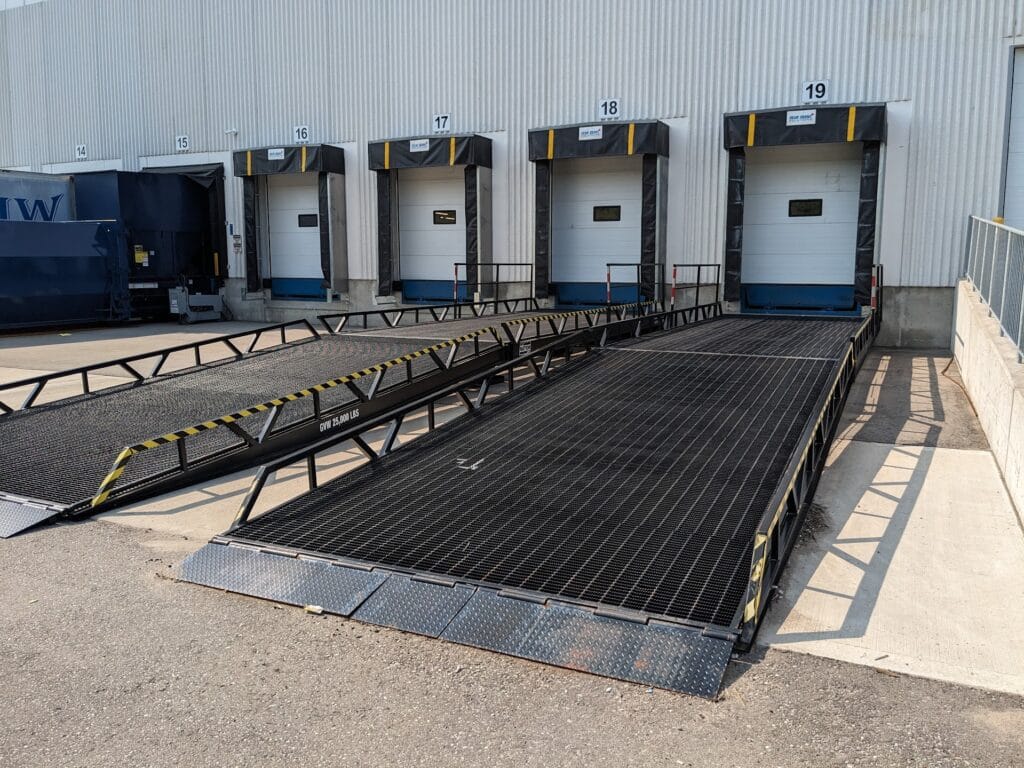
Ground-to-dock ramps are stationary steel structures that connect the ground level directly to the dock height. They give forklifts and vehicles a direct, uninterrupted path into the loading bay. Warehouses and distribution centers without raised dock bays use these ramps as a permanent loading infrastructure solution.
The incline spans a longer distance to maintain a manageable gradient for loaded forklifts and pallet equipment. Anchored in place and manufactured for high-traffic daily use, these ramps suit facilities with consistent inbound and outbound freight volume and enough open yard space to accommodate the ramp footprint.
They are most effective in environments where operations occur at ground level, and the building itself does not include a built-in dock system.
Portable Loading Ramps
Portable loading ramps offer a flexible alternative to permanent structures. These ramps can be moved to different locations around a facility or job site using a forklift or tow system. They are commonly used in industries that require temporary loading setups or mobile warehousing.
The portability of these ramps makes them popular for short-term needs, such as seasonal increases in shipping or when servicing multiple loading points. Since they can be relocated with relative ease, businesses often use them as a cost-saving solution when building a permanent dock isn’t feasible.
They are especially beneficial for contractors and mobile operations that need the freedom to load and unload at multiple sites.
Mobile Yard Ramps
Mobile yard ramps are a specific subtype of portable ramps designed to allow forklifts to access trailers or containers directly from the ground. They often feature tow-ready wheels and adjustable height options to accommodate different trailer heights.
These ramps excel in outdoor conditions and are commonly used in freight yards or temporary work sites. The adjustable-height component is especially useful when working with different trailer types or on uneven terrain.
Besides being used for trailer access, they can also serve as bridge ramps between buildings or storage areas.
Dock-to-Ground Ramps
Similar to ground-to-dock ramps but in reverse, dock-to-ground ramps allow vehicles or equipment to exit a raised dock and descend to ground level.
These ramps are fixed and typically used in facilities that load equipment or goods from inside a building to outdoor areas such as yards, lots, or delivery zones.
They are meant for buildings that already have docks but need a consistent pathway to ground level. They eliminate the need for forklifts to circle around the building or use alternate routes.
In many industrial settings, these ramps simplify the movement of large items or machinery from indoor storage to exterior transport vehicles.
Railcar Loading Ramps
For facilities that load or unload railcars, a railcar loading ramp is a specialized solution. These ramps are designed to connect railcars to a building or the ground, depending on the layout. They require high load capacity and must account for the width and alignment of the railcars in use.
Railcar ramps are most often custom-engineered. Since train-to-facility transfers involve specific clearance and safety considerations, these ramps must meet strict regulations. Their design typically features side curbs, anti-slip surfaces, and secure anchoring to avoid shifting during loading operations.
Modular Ramps
Modular ramps are built from prefabricated segments that can be assembled and customized based on your facility’s layout. These ramps allow for future modifications, extensions, or relocations. They’re great for growing businesses or multi-purpose operations.
Since they can be configured to fit evolving floor plans or access points, modular ramps serve as a flexible, long-term option. You can start with a basic configuration and expand as your needs grow.
Their construction allows replacement of individual sections, making maintenance simple and affordable.
Heavy-Duty Equipment Loading Ramps
Facilities that regularly move bulldozers, tractors, excavators, and other large construction or agricultural machinery need equipment loading ramps engineered specifically for high-weight loads.
These ramps feature:
- Reinforced steel frames: Rated for the concentrated loads generated by heavy machinery traveling on and off the ramp deck
- Wider deck dimensions: Accommodate the footprint of oversized vehicles and reduce the risk of equipment drift toward the ramp edge
- Steel serrated bar grating surfaces: Maintain traction under the weight of heavy machinery in wet, dry, and cold conditions
- Safety curbs: Keep equipment tracking straight along the ramp deck during loading and unloading
Heavy-duty equipment ramps are available in both fixed and portable configurations, depending on whether the machinery loading point is consistent or changes between sites and seasons.
Specialty Ramps for Unusual Applications
In some cases, loading operations involve nonstandard equipment or architectural constraints. Specialty ramps are custom-designed to accommodate these situations. These may include split-level ramps, loading bridges over obstacles, or ramps made to fit irregular vehicle types.
Because they are engineered for specific situations, specialty ramps must be designed and installed by experienced professionals. These ramps are ideal when off-the-shelf options don’t meet the physical demands of your site.
They often incorporate safety features like railings, integrated lighting, or wider tracks for unique equipment profiles.
Choosing the Right Ramp Type for Your Operation
Matching the ramp type to the facility and operational profile is what determines whether loading infrastructure adds value or creates friction. Key considerations include:
- Freight volume and frequency: High daily traffic favors fixed, permanent installations with lower per-cycle setup requirements
- Equipment type and weight: Heavy machinery requires reinforced steel with high load ratings and appropriate surface traction
- Location consistency: Operations that move between sites or reposition loading points benefit from portable or modular configurations
- Facility infrastructure: Buildings without existing dock bays need ground-to-dock solutions; facilities with existing docks may need dock-to-ground or specialty configurations
- Budget profile: Portable ramps reduce upfront costs; permanent installations deliver better long-term value for consistent, high-volume operations
Knowing your operational flow in detail is what turns this list into a practical specification rather than a general comparison.
Loading Dock Ramp Support from a Trusted Source
Nation Ramps has customized solutions to match every loading requirement. Our experience across North America means we understand what works in every industry and climate. From urban distribution centers to rural construction yards, our ramps are designed for real-world demands.
We manufacture in both the United States and Canada, which allows us to deliver fast and reliably across the continent. Our ramps are built to meet safety regulations, and our team works closely with you to determine the ideal setup for your space.
Whether you’re looking for new or used, permanent or portable, our experts can help you make the right choice.
Our ramp inventory includes everything from portable loading ramps to custom-engineered structures. If you need a dependable ramp supplier who puts customer needs first, we’re here to support you.
Every ramp we build reflects our commitment to quality, performance, and service. We don’t just sell ramps; we support your entire operation from delivery through setup.
If you’re ready to discuss your ramp options or want to explore different models like equipment loading ramps, we’d love to hear from you.
Contact us today, and let’s talk about how Nation Ramps can support your next move.
FAQs
What is the difference between a ground-to-dock ramp and a dock-to-ground ramp?
A ground-to-dock ramp connects grade level to dock height, allowing vehicles and forklifts to access a raised loading bay. A dock-to-ground ramp runs in the opposite direction, providing a pathway from an existing raised dock down to ground level for outbound freight or equipment.
Can heavy machinery use a portable loading ramp?
Yes. Heavy-duty portable steel ramps are available with load ratings suited for forklifts, bulldozers, and large agricultural equipment. The key is matching the ramp’s rated weight capacity to the heaviest equipment load, including dynamic forces during travel on the ramp surface.
When should a facility invest in a custom ramp rather than a standard model?
Custom ramps are the practical choice when standard dimensions, load ratings, or slope angles do not fit the specific facility or equipment requirements. Unusual dock heights, non-standard vehicle widths, restricted floor space, and specialized freight handling processes are the most common triggers for a custom specification.