
Loading Dock Equipment Upgrades That Help Miami Facilities Stay Productive Year-Round
Quick Summary
Miami facilities can improve loading productivity by upgrading equipment that no longer fits current trailer heights, traffic or project needs. Mobile, equipment, rental, used and custom ramp options can add flexibility, while drainage, corrosion checks and wet-weather procedures remain part of year-round operation.
Loading dock equipment in Miami has to support year-round freight activity while operating through heat, humidity and periods of heavy rain. An upgrade should improve the actual workflow, not simply replace old equipment with a newer version of the same limitation. Start with capacity, movement patterns, drainage and how often the loading point needs to change.
At Nation Ramps, we provide new, used, rental, lease and custom systems for warehouses, construction operations and industrial facilities. Our Loading Ramp Solutions in Miami, Florida give local teams several ways to add or reconfigure loading access.
Upgrade When Existing Equipment Limits The Workflow
Common signs include repeated bottlenecks, a mismatch between ramp height and current trailers, inadequate width for equipment, damaged surfaces or a loading point that cannot move with the operation. If teams regularly improvise around the existing setup, the equipment may no longer fit the process.
An upgrade should be based on the maximum loaded equipment weight, usable width, approach distance, trailer or dock height and expected traffic. equipment loading ramps are available in standard 30,000, 50,000 and 70,000 lb GVW models for heavy machinery applications. Load ratings vary by application — contact our team for specs tailored to your use case.
Mobile Loading Equipment Can Support Flexible Miami Operations
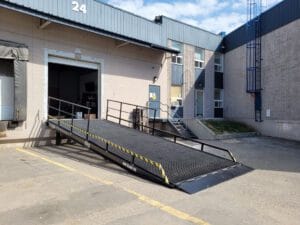
A mobile dock ramp can help facilities that use multiple doors, temporary loading zones or changing project areas. Mobile loading docks are designed to be repositioned and can support operations that would be constrained by a fixed loading point.
For temporary requirements, professional loading ramps for heavy equipment can provide access without a full purchase commitment. Contact Nation Ramps to check availability and pricing in your area.
Plan For Rain, Drainage And Corrosion Exposure
Miami’s outdoor loading areas need a clear water-management plan. Drainage around the ramp and its transitions should prevent standing water from becoming a routine operating condition. High-traction surfaces can help, but housekeeping and inspection remain necessary during wet weather.
Humidity and coastal exposure can also make coating conditions and corrosion checks more important. Include rails, supports, fasteners, transition components and the underside of the ramp in the inspection routine, not just the deck that operators see every day.
Choose Upgrades That Improve More Than One Bottleneck
An effective upgrade should solve several operational issues at once when possible. For example, an adjustable ramp can accommodate a wider range of trailer heights while a mobile system can also be moved to the door where capacity is needed. That flexibility may reduce trailer repositioning and unnecessary material handling.
Review the full loading cycle before deciding what to replace. A faster ramp does not help if the approach lane is too tight, the turning area is blocked or the dock team cannot stage freight near the loading point. Equipment and layout should be evaluated together.
Used Equipment Can Be A Practical Upgrade Path
When the required size and capacity are available, used equipment loading ramps can be evaluated alongside new equipment. Review the specific unit’s model, rated capacity, dimensions and condition and confirm that it fits the site before planning around it.
A used option is not automatically the right choice for every facility. If the Miami site has unusual geometry, multiple trailer heights or specialized equipment, a Custom Loading Ramp may provide a better long-term fit.
Keep Safety Controls Current After An Upgrade
For U.S. general-industry operations, OSHA 29 CFR 1910.178 addresses powered industrial trucks. New equipment does not replace operator training, inspections, traffic controls or site-specific procedures. A qualified safety professional should review the loading area and determine which requirements apply.
After installation or repositioning, verify approach paths, transitions, clearances, lighting and pedestrian separation before normal use. If the ramp is mobile, repeat the site check whenever it is moved to a new loading point.
Include Storm And Continuity Planning
South Florida facilities should also consider what happens when normal loading areas are temporarily unavailable. Portable or mobile equipment can support a contingency plan, but the facility still needs clear rules for when operations pause because of severe weather and how equipment is secured or relocated.
Delivery and setup planning should account for truck access, staging space, drainage and the final operating route. After placement, verify transitions and clearances and brief operators on the approved path before returning the area to normal use.
For multi-site operators, standardizing inspection steps and operator expectations across locations can make portable equipment easier to manage. The specific ramp may change, but the process for confirming capacity, placement, traffic flow and condition should stay consistent.
A facility should also decide who owns day-to-day inspection and who has authority to stop use when weather, damage or site conditions create a problem. Clear responsibility helps keep a new ramp from becoming another unmanaged piece of yard equipment.
Plan A Miami Loading Dock Upgrade Around The Operation
The best upgrade is the one that removes a real constraint from the loading process. Share your loaded equipment weights, trailer heights, site dimensions, traffic pattern and project duration with Nation Ramps so we can compare new, used, rental, lease and custom options for year-round use.
FAQs
What loading dock upgrades can improve flexibility in Miami?
Mobile loading docks, equipment ramps, portable docks, ground-to-dock systems and custom configurations can all improve flexibility depending on the site’s height, traffic and equipment requirements.
Should a Miami facility rent equipment during a temporary demand spike?
Rental can be useful for temporary projects, facility work or short-term volume increases. Contact Nation Ramps to check availability and pricing in your area.
How should facilities plan for heavy rain around a ramp?
Keep drainage paths clear, inspect transitions and travel surfaces and use site procedures for wet-weather operation. If water changes traction or creates unsafe conditions, pause use until the area is corrected.