
Choosing A Heavy-Duty Yard Ramp For Louisville, KY Manufacturing Facilities
Quick Summary
A heavy-duty yard ramp for a Louisville manufacturing facility should be selected around maximum loaded weight, height, width, traffic frequency, yard geometry and project duration. New, used, rental, lease and custom options can support permanent production as well as shutdowns, expansion and temporary capacity.
Selecting a yard ramp in Louisville KY should start with the manufacturing process it needs to support. A ramp used for finished-goods shipping has different demands from one used to move tooling, raw materials or heavy machinery. Capacity, width, height, traffic frequency and yard layout all need to match the real operating conditions.
At Nation Ramps, we provide new, used, rental, lease and custom loading systems for manufacturing and logistics operations. Our commercial ramp solutions can be configured for facilities that need broader loading access, while Louisville operations can also review our Loading Ramp Solutions in Louisville, Kentucky when planning local equipment needs.
Start With The Maximum Loaded Weight
The most important number is not the empty forklift weight. Use the maximum operating weight of the forklift or vehicle plus the heaviest load it will carry. A manufacturing site should also account for attachments, specialized equipment and future load changes rather than sizing only for today’s lightest task.
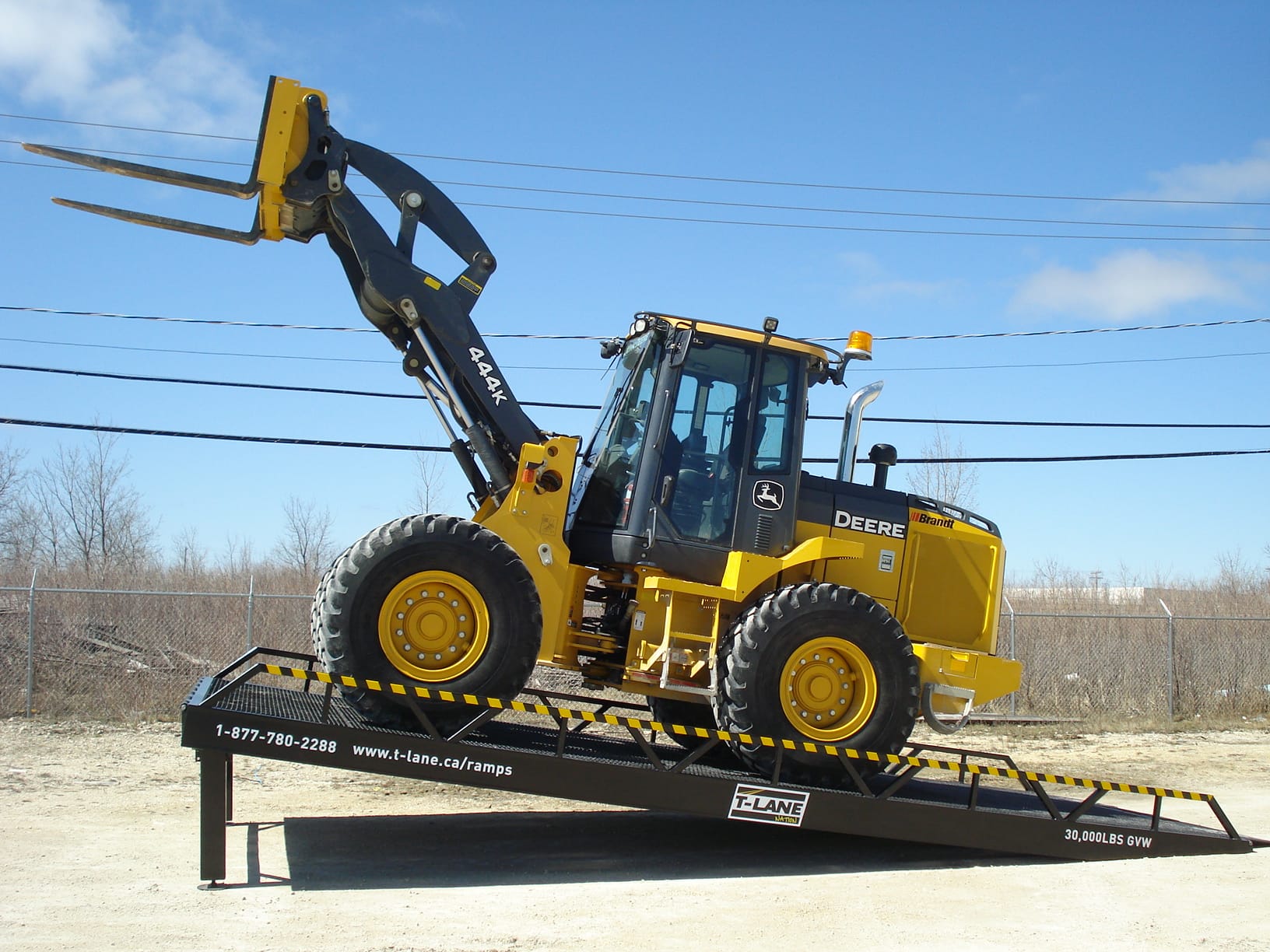
Nation Ramps offers several product families with different rated capacities. Equipment Loading Ramps include standard models rated at 30,000, 50,000 and 70,000 lb GVW, while other ramp systems use different ranges. Load ratings vary by application — contact our team for specs tailored to your use case.
Check Height, Width And Approach Geometry
A heavy-duty ramp has to fit the yard as well as the load. Measure the dock or trailer height, usable lane width, available straight approach and turning room. The loaded forklift should be able to enter, travel and exit without forcing sharp turns at transitions.
If the facility needs a regular connection between grade and an elevated dock, Ground to Dock Ramps may be more appropriate than a portable yard ramp. If loading points change during production or construction, a mobile or portable solution can provide more flexibility.
Choose A Configuration That Fits Manufacturing Traffic
Manufacturing traffic is often less predictable than simple pallet transfer. A ramp may need to support forklifts carrying raw material in one shift and maintenance equipment or finished assemblies in another. Document every regular user of the ramp and identify the heaviest and widest combination before finalizing the configuration.
Traffic frequency matters as well. A ramp used continuously across multiple shifts should be selected and maintained for that duty cycle. If the facility only needs occasional access for maintenance shutdowns or equipment installation, a temporary configuration may be sufficient and easier to remove when the project ends.
Evaluate Surface And Outdoor Conditions
Louisville manufacturing facilities may operate through rain, summer heat and winter freeze-thaw conditions. Outdoor ramp selection should consider traction, drainage and the site’s maintenance plan. Serrated steel grating can help provide traction while allowing water and debris to pass through.
The travel surface still needs routine inspection and housekeeping. Oil, packaging material, mud, ice and damaged components can change how a ramp performs. Establish inspection responsibilities before the equipment goes into daily service.
Decide Whether The Need Is Permanent Or Temporary
A long-term production line may justify a purchase, while shutdown work, expansion, seasonal volume or a temporary building can favor rental. Our ramp & platform rental services cover several loading configurations for temporary and longer-term requirements. Contact Nation Ramps to check availability and pricing in your area.
Used equipment can also be considered when a suitable unit is available. The decision should be based on capacity, dimensions, condition and site fit rather than price alone. A manufacturing facility that expects its process to change may also benefit from lease flexibility.
Use Site-Specific Safety Controls
For U.S. general-industry facilities, OSHA 29 CFR 1910.178 addresses powered industrial trucks. A heavy-duty ramp does not replace operator training, inspections, traffic controls or site-specific procedures. A qualified safety professional should review the loading area and determine which requirements apply.
Pedestrian separation, truck restraint practices, lighting, visibility and communication between drivers and forklift operators should all be reviewed as part of the loading process. Where standard products do not fit, Custom Loading Ramps can be engineered around site constraints and specialized equipment.
Plan Delivery And Setup Around Production
Manufacturing facilities should coordinate delivery with production schedules so the ramp can be unloaded, positioned and checked without blocking material flow. Confirm transport access, staging space, overhead clearance and the route the delivery vehicle will use before the equipment arrives.
Before release to normal traffic, verify the ramp position, transitions, supports and clearances. Operators should understand the approved route and supervisors should know how to report damage or changing conditions. This is especially important when the ramp is introduced during an expansion or temporary production change.
Future expansion should also be considered. If the plant expects new production lines, heavier equipment or different trailer types, tell the supplier before final sizing. A slightly more flexible configuration may prevent an early replacement when the workflow changes.
Match The Ramp To Your Louisville Manufacturing Workflow
A heavy-duty yard ramp should fit the load, site and production schedule rather than forcing the operation to adapt around it. Share your equipment weights, heights, dimensions and expected duration with Nation Ramps so we can compare standard, custom, rental, lease, new and used solutions for the facility.
FAQs
What makes a yard ramp heavy duty?
Heavy-duty performance comes from the complete engineered system, including structural capacity, deck construction, transitions, support configuration and fit for the intended equipment. Capacity alone does not determine whether a ramp is right for the application.
Should a Louisville manufacturer rent or buy a portable yard ramp?
Buying is often appropriate for stable long-term use. Renting can be useful for shutdowns, temporary production, construction or demand spikes. Lease and used options may also fit. Contact Nation Ramps to check availability and pricing in your area.
How often should a yard ramp be inspected?
Inspection frequency should reflect use, exposure and the manufacturer’s guidance. Facilities should check the travel surface, transitions, rails, supports and surrounding area and address damage or unsafe conditions before continued use.