Rail Car Ramps for Sale: Heavy-Duty Rail Loading Solutions
Complete Rail Loading Access Solutions
Transform your rail operations with North America’s premier rail car loading systems. Optimize your rail yard efficiency with loading solutions specifically engineered for multi-car access and heavy-duty rail operations.
Find the Right Rail Car Loading Solution for Your Site
Quick Summary
Rail car ramps for sale should be selected around the actual rail-car floor height, maximum loaded equipment weight, usable width, approach geometry, fork-pocket access, and site safety requirements. Many rail-loading applications fall roughly 36 to 48 inches above the top of rail, but car designs vary, so the exact floor height must be measured rather than assumed. Nation Ramps supports single-car and multi-car loading with heavy-duty, adjustable systems that can be configured around the operating environment.
Rail car ramps for sale from Nation Ramps are engineered for single-car and multi-car loading operations where floor height, equipment clearance, load demands, and positioning all affect performance. These heavy-duty systems support rail yards, distribution centers, and industrial facilities that need dependable access for loading and unloading.
If the primary requirement is moving heavy machinery rather than building out a rail-loading position, compare Nation Ramps’ Equipment Loading Ramps to determine whether a rail-specific platform or a dedicated equipment ramp is the better fit for the workflow.
Nation Ramps designs professional-grade rail loading systems for loading, unloading, and multi-car operations. The right configuration depends on the rail-car interface, the material-handling equipment, the maximum loaded operating weight, the number of cars that need access, and how the system will be positioned within the yard or facility.
For operations that need an elevated staging area or multiple access points, Stand Alone Platforms can be incorporated into broader loading layouts. Nation Ramps’ rail systems also use modular concepts such as multi-piece construction and repositionable components to support changing access requirements.
Gallery
Completed Rail car Solutions
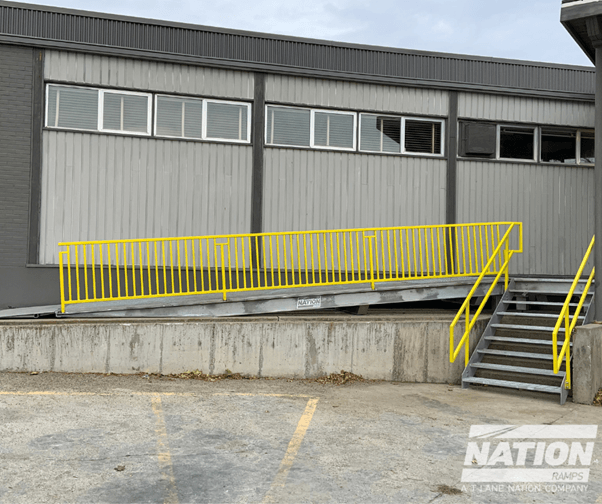
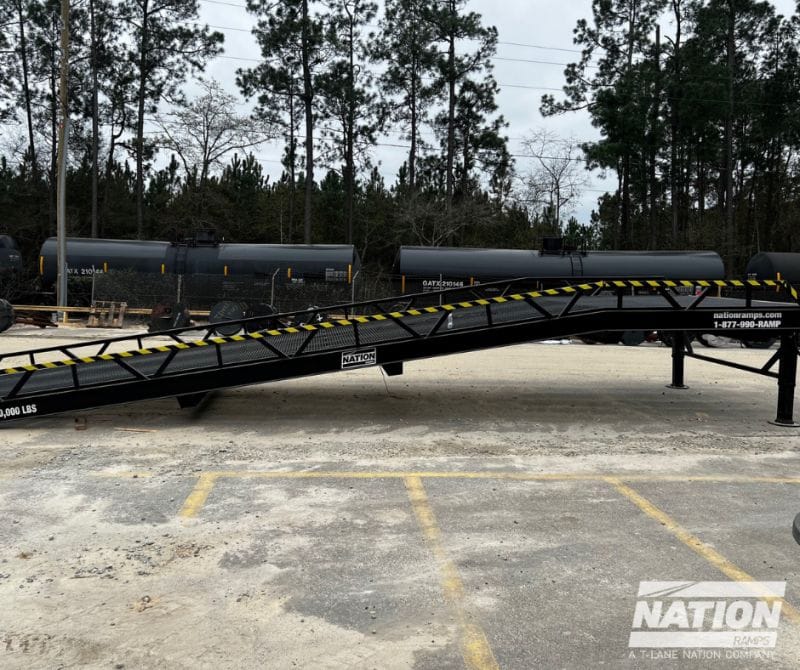

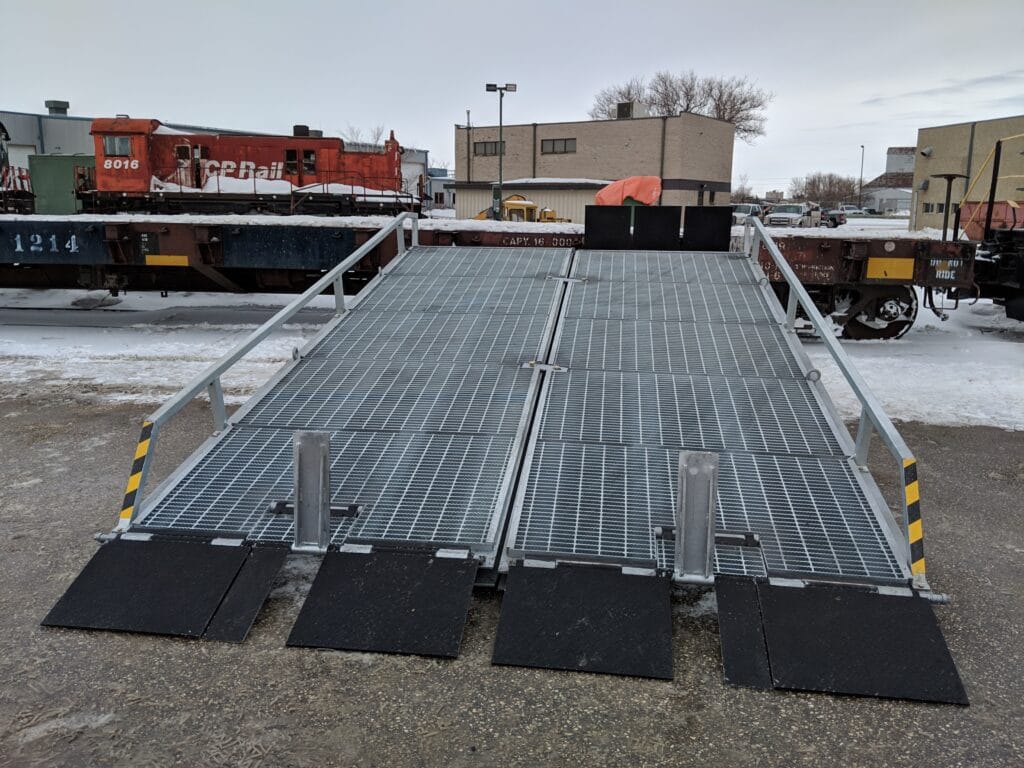
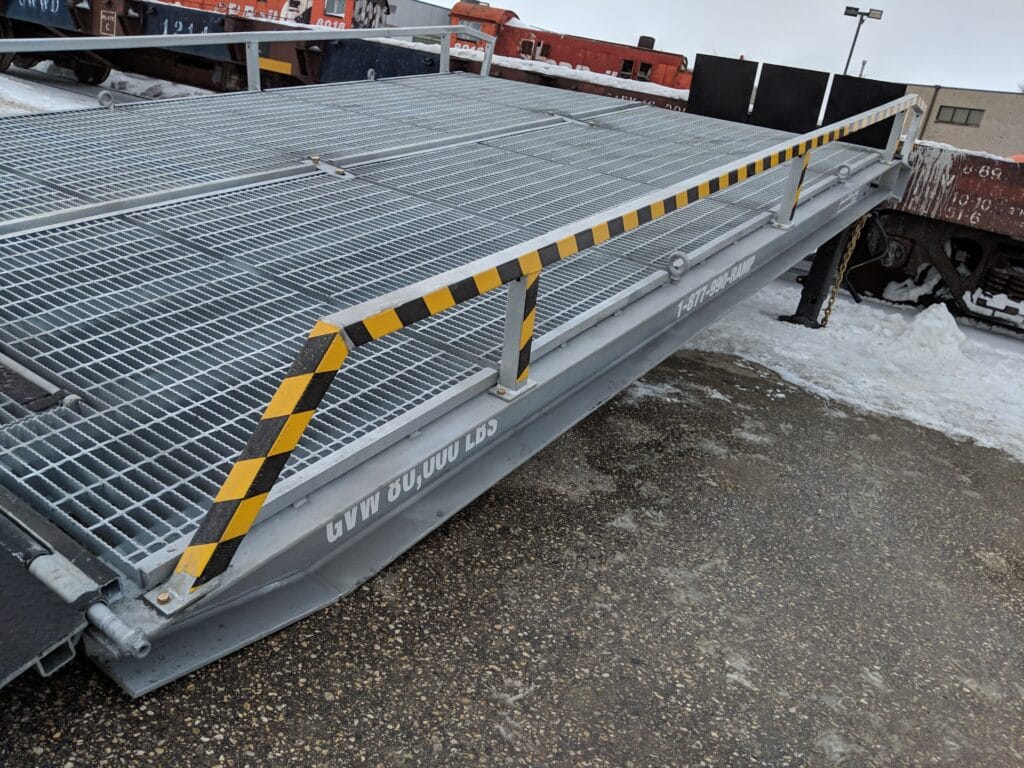
Serving North America
Manufactured in USA & Canada
From single car access to multi-car operations, our rail loading solutions deliver efficient, reliable access for your rail yard operations.
nation ramps
Engineered for rail Operations
Add-Ons
Optimize Your Rail Car Ramp
Transform your operations with our professional-grade rail loading upgrades
Height Adjustment
– Two-speed hand crank
– Quick height changes
– Custom positions
– Level indicators

Safety Features
– Removable guard rails
– Anti-slip surfaces
– Visual markers
– Safety chains

Operational Add-Ons
– Extended platforms
– Multi-car access
– Position locks
– Alignment guides

Surface Options
– Serrated steel grating
– Weather
-resistant coating
– Heavy-duty deck
– Custom colors
Measure Rail-Car Floor Height Before Selecting a Ramp
Rail-car floor height is one of the first dimensions to document because it determines the working height and transition geometry of the loading system. A rough planning range of about 3 to 4 feet above the top of rail is common in many rail-loading applications, but there is no single universal rail-car floor height. Car type, suspension, loading condition, track geometry, and the specific fleet can change the required interface height.
Before ordering, measure the actual top-of-rail-to-floor or deck height for the rail cars that will use the system and identify the lowest and highest expected positions. Also record usable door or deck width, approach space, grade, track-to-platform clearances, and any obstruction that could affect forklift turning or ramp placement. When those dimensions fall outside a standard configuration, Custom Loading Ramps allow the system to be engineered around the site rather than forcing the operation to adapt to an unsuitable ramp.
Plan Fork-Pocket Clearance and Ramp Positioning
Nation Ramps lists fork-pocket mobility and position flexibility among its rail-loading features. That makes forklift access to the ramp components part of the site-planning process, not an afterthought. Confirm the fork dimensions, insertion depth, pocket location, lifting approach, turning radius, and clearance around the track before the system arrives.
For multi-car loading, also consider how often sections will be repositioned, where the forklift can safely approach, and whether stored or parked ramp components could interfere with rail movement, pedestrian routes, or other material-handling traffic. A technically suitable ramp can still create operational friction if the yard does not provide enough room to lift, turn, position, and secure the equipment efficiently.
Rail Yard Safety and Regulatory Considerations
For U.S. industrial facilities where OSHA standards apply, rail-loading plans should account for applicable requirements in 29 CFR 1910. OSHA 29 CFR 1910.178 addresses powered industrial trucks and railroad cars, while 29 CFR 1910.26 addresses dockboards. Among other requirements, railroad cars must be protected against unintended movement during loading or unloading, dockboards must support the maximum intended load, and portable dockboards must be secured or otherwise prevented from moving out of a safe position.
- Prevent rail-car movement during loading and unloading and while dockboards or bridge plates are in position, consistent with applicable OSHA requirements.
- Confirm the ramp, dockboard, or platform is rated for the maximum intended load and that the forklift or vehicle remains within its own rated capacity.
- Check rail-car floors and travel surfaces for breaks, weakness, debris, or other conditions before powered industrial trucks enter the loading area.
- Maintain safe clearance from ramp, platform, dock, and freight-car edges and train operators for the specific loading environment and equipment.
These are not substitutes for a site-specific safety review. Consult a qualified safety professional and the rail operator for the exact application. For Canadian facilities, reference applicable CSA standards and provincial workplace-safety or WCB requirements rather than applying U.S. OSHA language.
Match Capacity, Surface, and Multi-Car Access to the Operation
Rail-loading equipment should be specified around the heaviest loaded forklift, vehicle, machinery, or other transfer equipment that will use the system. Include the operator, attachments, payload, and any dynamic or concentrated loading considerations in the application review. Load ratings vary by application – contact our team for specs tailored to your use case.
Nation Ramps’ rail-loading systems emphasize heavy-duty structural design, reinforced platforms, serrated steel grating, adjustable-height features, removable safety components, and multi-car access options. The best combination depends on traffic frequency, weather exposure, surface traction needs, number of loading positions, and whether the system must be moved between cars or remain in a more fixed position.
If the project requires loading access to be coordinated with delivery, rigging, positioning, or setup, Nation Ramps’ Logistics & Installation Services can support the transition from equipment selection to site placement. Confirm service scope and timing for the specific location and configuration.
When to Buy New, Buy Used, Rent, or Lease
The target application should drive the commercial option. Purchasing new can make sense for long-term rail operations that need a stable specification or custom configuration. If a suitable pre-owned unit is available, Used Rail Car Ramps may reduce the initial capital requirement, provided the exact condition, capacity, dimensions, and fit are verified before purchase.
For temporary projects, seasonal demand, or a requirement that may change, Nation Ramps also offers Ramp & Platform Rental Services. Availability and commercial terms vary by equipment and location, so confirm the current options for the project rather than assuming a specific unit is available.
Why Choose Nation Ramps for Rail Car Loading?
Nation Ramps combines 15+ years of ramp design experience with U.S. and Canadian manufacturing, custom engineering, and buy, rent, or lease flexibility. For rail-loading projects, the practical advantage is the ability to match the system to the actual floor height, load, clearances, movement pattern, and site constraints instead of treating rail access as a one-size-fits-all product.
That engineering-first approach is particularly useful for multi-car operations, unusual rail-car interfaces, heavy equipment movement, or facilities where fork-pocket access and component positioning must be planned around tight yard geometry.







Customer Success Stories
Testimonials
“The team at Nation Ramps took on the challenge and delivered a ramp system that far exceeded our expectations. This thing is indestructible. The building it is in will fall apart before the ramp does.”
Daniel Boyer – President at B.D.R. Safety Consulting
“Thank you so much for your service over the past year. Your firm helped support DC government, as we continued to serve DC residents throughout the pandemic.”
Tonia C. Nixon, CPM, MBA – Deputy Chief Contracting Officer, Office of Contracting and Procurement (OCP)
“Nation Ramps provided us with a custom solution that perfectly fit our unique loading dock challenges. Their expertise and attention to detail were invaluable.”
John Smith – Logistics Manager, XYZ Corporation
FAQs About Rail Car Ramps for Sale
Plan a Rail Car Ramp Around Your Actual Loading Requirements
Before requesting a configuration, document the rail-car floor height or range, maximum loaded equipment weight, usable width, fork dimensions, fork-pocket access, track and yard clearances, number of loading positions, and expected traffic frequency. Nation Ramps can use those details to help determine whether a standard, custom, used, rental, or lease solution is the better fit for the operation.
Ready for Efficient Rail Car Loading?
Take the first step towards professional rail loading solutions: